Prompt Target
Deprecated since version v0.4.22: Prompt Targets are deprecated and no longer actively maintained. This concept is
retained for existing users on older Plano configurations, but new applications should
not adopt it. For deterministic, task-specific workloads, use Agents
together with Function Calling instead. The
prompt_targets configuration block and related CLI commands will continue to
function for now, but may be removed in a future release.
A Prompt Target is a deterministic, task-specific backend function or API endpoint that your application calls via Plano. Unlike agents (which handle wide-ranging, open-ended tasks), prompt targets are designed for focused, specific workloads where Plano can add value through input clarification and validation.
Plano helps by:
Clarifying and validating input: Plano enriches incoming prompts with metadata (e.g., detecting follow-ups or clarifying requests) and can extract structured parameters from natural language before passing them to your backend.
Enabling high determinism: Since the task is specific and well-defined, Plano can reliably extract the information your backend needs without ambiguity.
Reducing backend work: Your backend receives clean, validated, structured inputs—so you can focus on business logic instead of parsing and validation.
For example, a prompt target might be “schedule a meeting” (specific task, deterministic inputs like date, time, attendees) or “retrieve documents” (well-defined RAG query with clear intent). Prompt targets are typically called from your application code via Plano’s internal listener.
Capability |
Description |
|---|---|
Intent Recognition |
Identify the purpose of a user prompt. |
Parameter Extraction |
Extract necessary data from the prompt. |
Invocation |
Call relevant backend agents or tools (APIs). |
Response Handling |
Process and return responses to the user. |
Key Features
Below are the key features of prompt targets that empower developers to build efficient, scalable, and personalized GenAI solutions:
Design Scenarios: Define prompt targets to effectively handle specific agentic scenarios.
Input Management: Specify required and optional parameters for each target.
Tools Integration: Seamlessly connect prompts to backend APIs or functions.
Error Handling: Direct errors to designated handlers for streamlined troubleshooting.
Multi-Turn Support: Manage follow-up prompts and clarifications in conversational flows.
Basic Configuration
Configuring prompt targets involves defining them in Plano’s configuration file. Each Prompt target specifies how a particular type of prompt should be handled, including the endpoint to invoke and any parameters required. A prompt target configuration includes the following elements:
name: A unique identifier for the prompt target.description: A brief explanation of what the prompt target does.endpoint: Required if you want to call a tool or specific API.nameandpathhttp_methodare the three attributes of the endpoint.parameters(Optional): A list of parameters to extract from the prompt.
Defining Parameters
Parameters are the pieces of information that Plano needs to extract from the user’s prompt to perform the desired action. Each parameter can be marked as required or optional. Here is a full list of parameter attributes that Plano can support:
Attribute |
Description |
|---|---|
|
Specifies name of the parameter. |
|
Provides a human-readable explanation of the parameter’s purpose. |
|
Specifies the data type. Supported types include: int, str, float, bool, list, set, dict, tuple |
|
Indicates whether the parameter is part of the path in the endpoint url. Valid values: true or false |
|
Specifies a default value for the parameter if not provided by the user. |
|
Specifies a format for the parameter value. For example: 2019-12-31 for a date value. |
|
Lists of allowable values for the parameter with data type matching the |
|
Specifies the attribute of the elements when type equals list, set, dict, tuple. Usage Example: |
|
Indicates whether the parameter is mandatory or optional. Valid values: true or false |
Example Configuration For Tools
prompt_targets:
  - name: get_weather
    description: Get the current weather for a location
    parameters:
      - name: location
        description: The city and state, e.g. San Francisco, New York
        type: str
        required: true
      - name: unit
        description: The unit of temperature
        type: str
        default: fahrenheit
        enum: [celsius, fahrenheit]
    endpoint:
      name: api_server
      path: /weather
Multi-Turn
Developers often struggle to efficiently handle
follow-up or clarification questions. Specifically, when users ask for changes or additions to previous responses, it requires developers to
re-write prompts using LLMs with precise prompt engineering techniques. This process is slow, manual, error prone and adds latency and token cost for
common scenarios that can be managed more efficiently.
Plano is highly capable of accurately detecting and processing prompts in multi-turn scenarios so that you can buil fast and accurate agents in minutes. Below are some cnversational examples that you can build via Plano. Each example is enriched with annotations (via ** [Plano] ** ) that illustrates how Plano processess conversational messages on your behalf.
Example 1: Adjusting Retrieval
User: What are the benefits of renewable energy?
**[Plano]**: Check if there is an available <prompt_target> that can handle this user query.
**[Plano]**: Found "get_info_for_energy_source" prompt_target in plano_config.yaml. Forward prompt to the endpoint configured in "get_info_for_energy_source"
...
Assistant: Renewable energy reduces greenhouse gas emissions, lowers air pollution, and provides sustainable power sources like solar and wind.

User: Include cost considerations in the response.
**[Plano]**: Follow-up detected. Forward prompt history to the "get_info_for_energy_source" prompt_target and post the following parameters consideration="cost"
...
Assistant: Renewable energy reduces greenhouse gas emissions, lowers air pollution, and provides sustainable power sources like solar and wind. While the initial setup costs can be high, long-term savings from reduced fuel expenses and government incentives make it cost-effective.
Example 2: Switching Intent
User: What are the symptoms of diabetes?
**[Plano]**: Check if there is an available <prompt_target> that can handle this user query.
**[Plano]**: Found "diseases_symptoms" prompt_target in plano_config.yaml. Forward disease=diabeteres to "diseases_symptoms" prompt target
...
Assistant: Common symptoms include frequent urination, excessive thirst, fatigue, and blurry vision.

User: How is it diagnosed?
**[Plano]**: New intent detected.
**[Plano]**: Found "disease_diagnoses" prompt_target in plano_config.yaml. Forward disease=diabeteres to "disease_diagnoses" prompt target
...
Assistant: Diabetes is diagnosed through blood tests like fasting blood sugar, A1C, or an oral glucose tolerance test.
Build Multi-Turn RAG Apps
The following section describes how you can easilly add support for multi-turn scenarios via Plano. You process and manage multi-turn prompts just like you manage single-turn ones. Plano handles the conpleixity of detecting the correct intent based on the last user prompt and the covnersational history, extracts relevant parameters needed by downstream APIs, and dipatches calls to any upstream LLMs to summarize the response from your APIs.
Step 1: Define Plano Config
 1version: v0.1
 2listener:
 3  address: 127.0.0.1
 4  port: 8080 #If you configure port 443, you'll need to update the listener with tls_certificates
 5  message_format: huggingface
 6
 7# Centralized way to manage LLMs, manage keys, retry logic, failover and limits in a central way
 8llm_providers:
 9  - name: OpenAI
10    provider: openai
11    access_key: $OPENAI_API_KEY
12    model: gpt-3.5-turbo
13    default: true
14
15# default system prompt used by all prompt targets
16system_prompt: |
17   You are a helpful assistant and can offer information about energy sources. You will get a JSON object with energy_source and consideration fields. Focus on answering using those fields
18
19prompt_targets:
20  - name: get_info_for_energy_source
21    description: get information about an energy source
22    parameters:
23      - name: energy_source
24        type: str
25        description: a source of energy
26        required: true
27        enum: [renewable, fossil]
28      - name: consideration
29        type: str
30        description: a specific type of consideration for an energy source
31        enum: [cost, economic, technology]
32    endpoint:
33      name: rag_energy_source_agent
34      path: /agent/energy_source_info
35      http_method: POST
Step 2: Process Request in Flask
Once the prompt targets are configured as above, handle parameters across multi-turn as if its a single-turn request
 1import os
 2import gradio as gr
 3
 4from fastapi import FastAPI, HTTPException
 5from pydantic import BaseModel
 6from typing import Optional
 7from openai import OpenAI
 8from common import create_gradio_app
 9
10app = FastAPI()
11
12
13# Define the request model
14class EnergySourceRequest(BaseModel):
15    energy_source: str
16    consideration: Optional[str] = None
17
18
19class EnergySourceResponse(BaseModel):
20    energy_source: str
21    consideration: Optional[str] = None
22
23
24# Post method for device summary
25@app.post("/agent/energy_source_info")
26def get_workforce(request: EnergySourceRequest):
27    """
28    Endpoint to get details about energy source
29    """
30    considertion = "You don't have any specific consideration. Feel free to talk in a more open ended fashion"
31
32    if request.consideration is not None:
33        considertion = f"Add specific focus on the following consideration when you summarize the content for the energy source: {request.consideration}"
34
35    response = {
36        "energy_source": request.energy_source,
37        "consideration": considertion,
38    }
39    return response
Demo App
For your convenience, we’ve built a demo app that you can test and modify locally for multi-turn RAG scenarios.
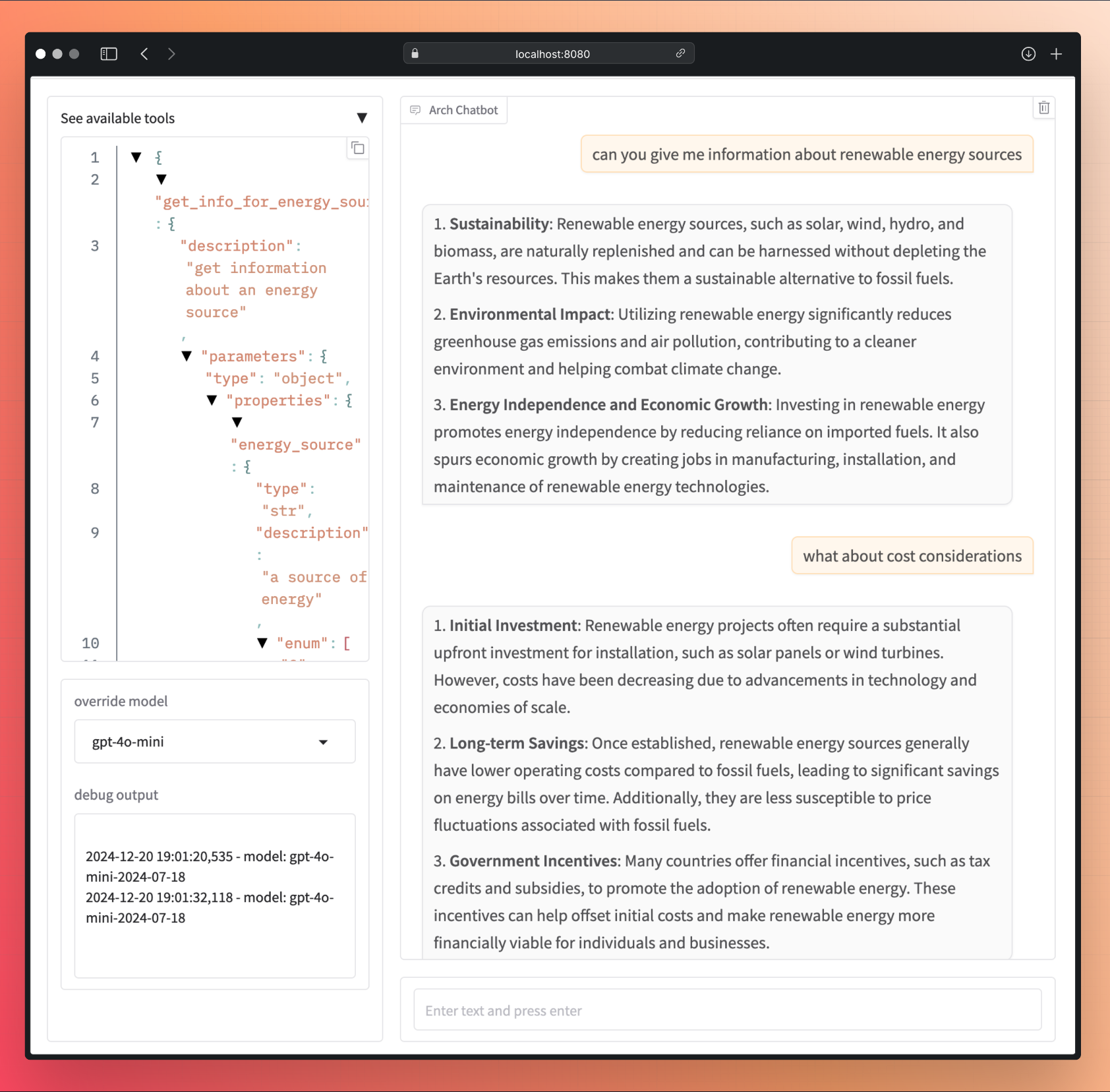
Example multi-turn user conversation showing adjusting retrieval
Summary
By carefully designing prompt targets as deterministic, task-specific entry points, you ensure that prompts are routed to the right workload, necessary parameters are cleanly extracted and validated, and backend services are invoked with structured inputs. This clear separation between prompt handling and business logic simplifies your architecture, makes behavior more predictable and testable, and improves the scalability and maintainability of your agentic applications.